If you're comparing Houston property management companies, you've probably seen the same thing over and over:
“Management starting at 7%!”
Sounds great.
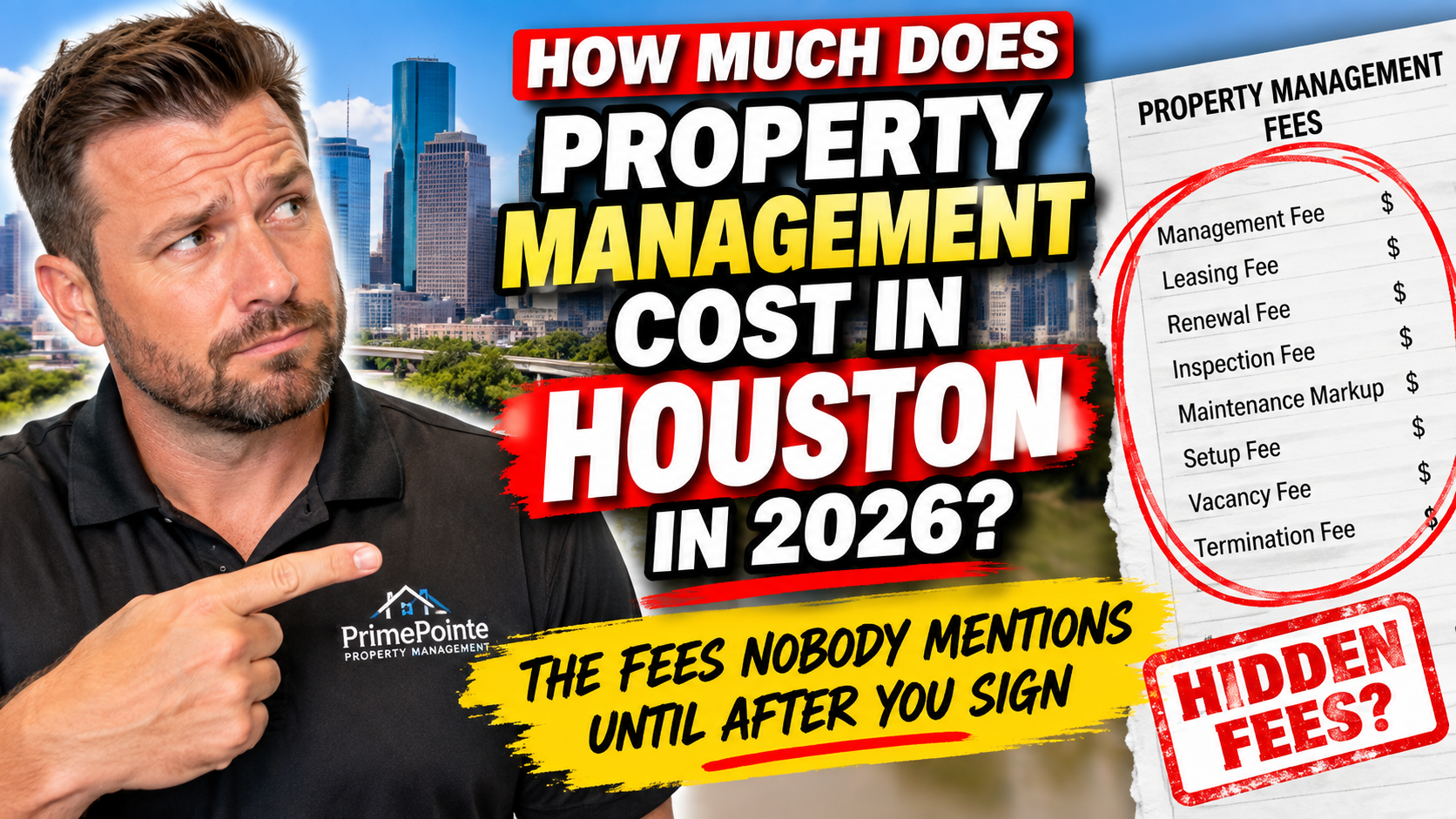
But that cute little 7% management fee isn't nearly as cute when five mystery charges show up behind it.
For Houston landlords, the number that matters isn't simply the monthly management percentage. It's the total cost of owning and managing the rental over the entire year.
And that is where comparing property management companies gets interesting.
Quick Answer: What Do Property Managers Typically Charge in Houston?
In 2026, many full-service Houston property management companies advertise monthly management fees around 8% to 12% of collected rent, although flat-rate and lower-percentage models also exist. Tenant placement commonly costs roughly 50% to 100% of one month's rent, and additional fees may apply for lease renewals, inspections, onboarding, maintenance coordination, evictions or other services.
So when someone tells you:
“Our management fee is only 8%.”
Your next question should be:
“Great. What will I actually pay you over the next 12 months?”
That's the number that matters.
1. The Monthly Property Management Fee
This is the number everybody advertises.
Houston property managers generally use one of two models:
Percentage-based management:
The company receives a percentage of rent each month.
Flat-fee management:
The landlord pays a set dollar amount regardless of monthly rent.
Published Houston pricing in 2026 commonly places percentage-based management somewhere around 8%–12%, although individual companies can fall above or below that range depending on services and portfolio size.
Let's use a Houston rental collecting $2,000 per month.
At:
8% = $160/month
10% = $200/month
12% = $240/month
That means the difference between an 8% and 12% manager is $960 per year before we add anything else.
But here's where landlords make the mistake:
They stop comparing there.
Don't.
2. The Leasing or Tenant Placement Fee
Your monthly management fee usually doesn't include finding a new tenant.
When your property becomes vacant, many Houston property managers charge a separate leasing or tenant-placement fee.
Current Houston pricing examples commonly range from approximately 50% to 100% of one month's rent.
For a $2,000 rental, that could mean:
50% placement fee = $1,000
75% placement fee = $1,500
100% placement fee = $2,000
Suddenly that company advertising an inexpensive monthly management fee might not be so inexpensive.
And don't automatically assume a higher placement fee is bad.
A leasing fee may include:
professional marketing
showing coordination
applicant communication
income verification
credit and rental-history screening
lease preparation
move-in coordination
agent commissions
The question isn't simply:
“How much is the leasing fee?”
The better question is:
“What am I receiving for the leasing fee?”
3. Lease Renewal Fees
You found a great tenant.
They pay on time.
They take care of your house.
They want to stay.
Excellent.
Now your property manager sends you a bill for renewing the lease.
Surprise.
Lease-renewal fees are common in property management, and current Houston pricing examples show flat renewal charges frequently in roughly the $150–$350 range, although some companies use percentages or different pricing structures.
Renewals do require work.
A good manager should be reviewing:
current market rent
tenant payment history
property performance
lease terms
renewal increases
new documentation
compliance requirements
There is absolutely value in properly managing a renewal.
The issue isn't that the fee exists.
The issue is discovering it after you've signed the management agreement.
4. Maintenance Markups and Coordination Fees
This is one landlords need to pay very close attention to.
Ask every property management company:
“Do you add anything to my contractor's invoice?”
Some property managers charge a maintenance coordination fee.
Some charge a percentage markup.
Some charge a dispatch fee.
Some have in-house maintenance.
Some pass vendor invoices directly through.
Current Houston pricing guides describe maintenance markups around 10%–15% at some companies, while other local managers publicly advertise no repair markup but charge separate dispatch or coordination fees.
Here's why that matters.
Imagine your rental needs $5,000 in repairs during the year.
A 10% maintenance markup adds:
$500
A 15% markup adds:
$750
That doesn't automatically make the company bad.
Maintenance coordination costs money.
Someone is answering the tenant, diagnosing the problem, dispatching the contractor, following up, reviewing the invoice and keeping you informed.
But you should know exactly how the company makes money from maintenance before you sign.
Mystery math belongs in escape rooms, not your owner statement.
5. Setup and Onboarding Fees
Some management companies charge a one-time onboarding or account setup fee.
Current Houston pricing examples range from companies offering $0 setup to others charging approximately $100–$300, depending on the company and service package.
Again, a setup fee isn't inherently a problem.
Proper onboarding can include:
reviewing your lease
setting up accounting
creating your owner portal
collecting tenant records
transferring deposits
obtaining keys and access codes
reviewing property condition
setting up vendor and maintenance information
The question is whether you're receiving something for the fee.
6. Property Inspection Fees
Don't assume inspections are included.
Some Houston property managers include periodic inspections in their regular management service.
Others charge separately.
Published 2026 Houston pricing guidance places individual inspection charges around $75–$150 in some models.
Ask:
How often will you actually inspect my rental?
Because there is a major difference between:
“We can inspect it.”
and:
“We inspect it every six months.”
Your investment shouldn't require a tenant moving out before anyone discovers what has been happening inside.
7. Vacancy Fees
This one is easy to miss.
Ask whether management fees continue when the property is vacant.
Some Houston managers charge nothing when there is no collected rent. Others use minimum fees, reduced vacancy fees or flat monthly pricing. Current Houston companies publicly advertise several different approaches.
This is particularly important because your interests should be aligned.
When your property is vacant, you're already losing money.
Mortgage.
Taxes.
Insurance.
Utilities.
Lawn care.
Potential maintenance.
And zero rent coming in.
You probably don't want your property manager becoming another large vacancy expense.
8. Cancellation and Termination Fees
Here's one landlords usually discover when they're already unhappy.
“What does it cost me to fire you?”
Read that section before you sign.
Not after you're angry.
Some agreements may require advance notice. Others may have early-termination charges or fees that survive termination.
You should understand:
How much notice is required?
Is there a termination fee?
Are future management fees accelerated?
Who receives security deposits?
Who receives tenant records?
What happens to unpaid vendor invoices?
When do you receive your final accounting?
Your exit should be just as clear as your entrance.
9. Eviction Fees and Protection Programs
Hopefully you'll never need this section.
But hope isn't much of an operating procedure.
Ask whether your management agreement includes:
notice-to-vacate preparation
court filing coordination
court appearance
attorney fees
writ-of-possession coordination
lost-rent protection
tenant-damage protection
Some companies include parts of this.
Some sell protection packages.
Some charge separately every time something happens.
Know which one you're hiring.
The Number Houston Landlords Should Actually Compare
Let's say two Houston property managers are competing for your $2,000-per-month rental.
Company A
Management: 7%
Sounds fantastic.
But then:
Management: $1,680/year
Tenant placement: $2,000
Renewal: $300
Inspection: $125
Setup: $250
Maintenance markup: $400
Total potential cost: $4,755
Company B
Management: 9%
At first glance, it looks more expensive.
Management: $2,160/year
Tenant placement: $1,000
Renewal: $200
Inspection included
Setup included
No maintenance markup
Total potential cost: $3,360
Suddenly the “expensive” property manager is $1,395 cheaper.
Those numbers are illustrative, but that's exactly why comparing only the advertised management percentage can be misleading.
Compare the entire fee structure.
The 10 Questions to Ask Before Hiring a Houston Property Manager
Before you sign anything, ask:
What is my monthly management fee?
Do you charge management fees when no rent is collected?
What is your tenant-placement fee?
What do you charge for lease renewals?
Do you mark up maintenance invoices?
Do you charge maintenance dispatch or coordination fees?
Are property inspections included?
Is there an onboarding or setup fee?
What does it cost to terminate the agreement?
What other fee could appear on my owner statement that we haven't discussed yet?
That last question is my favorite.
Then stop talking.
Let them answer it.
Cheap Property Management Can Get Expensive Quickly
We're not suggesting you should hire the most expensive property management company in Houston.
We're also not suggesting the cheapest company can't be excellent.
We're saying something much simpler:
Know what you're buying.
A management company charging 7% with six additional fees can easily cost more than one charging 9% with most services included.
And price shouldn't be your only consideration anyway.
You're trusting this company with:
your property
your tenant
your rent
your repairs
your legal notices
your accounting
and potentially a very expensive asset
Saving $30 a month isn't much of a victory if nobody answers the phone when the A/C dies in August.
How PrimePointe Looks at Property Management Pricing
At PrimePointe Property Management, we believe owners should understand the complete fee structure before they sign the management agreement.
Not three months later.
Not after a maintenance invoice.
And definitely not while trying to figure out why their owner statement suddenly looks like a CVS receipt.
Our goal is to help Houston landlords understand what they're paying for, what is included, and how their management costs affect the actual performance of their investment.
Because property management isn't supposed to create another problem for the landlord.
That's kind of the whole reason you hired us.
By PrimePointe Property Management - Tuesday, September 29, 2026
Author